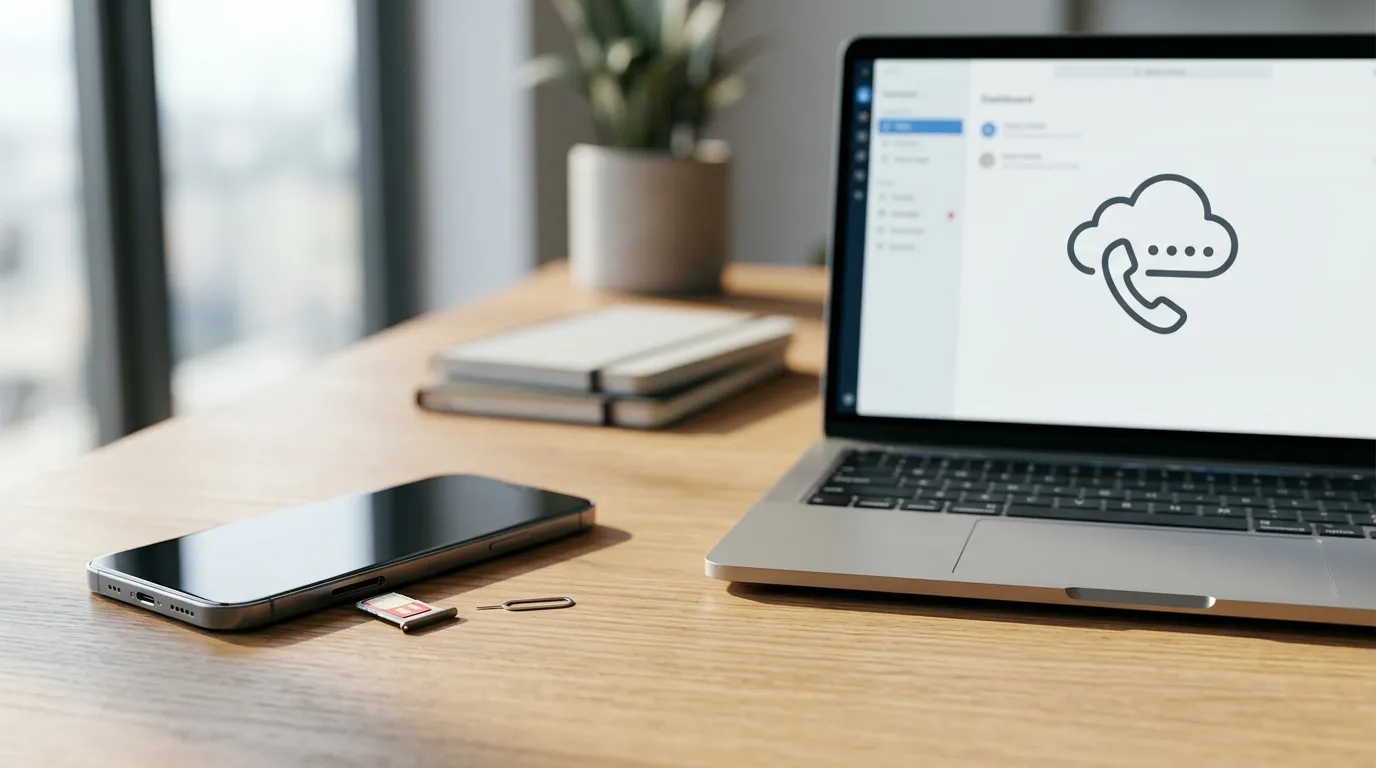
When it's time to set up WhatsApp Business for the business, a decision comes up that looks small but has real consequences: virtual number or physical SIM? Neither option is "the right one" in the abstract — it depends on how you're going to use that number. Let's break it down.
The physical SIM: the familiar path, with its limits
Using a physical SIM means buying (or reusing) a phone, signing up for a line with a local carrier, inserting the card, and verifying WhatsApp Business from that device. It's the more familiar route, and it makes sense if:
- You already have a company phone dedicated exclusively to that line.
- You only operate in the country where you hold the carrier contract.
- You prefer having physical control of the device.
The problem shows up when the business grows or decentralizes: every new line means a new phone, a new contract, and one person responsible for holding onto it. If that person changes roles or leaves the company, the number — and with it, the entire conversation history — leaves too, unless you've managed that handover very carefully.
The virtual number: no phone, no local contract
A virtual number solves exactly those friction points: you buy it from a panel, it doesn't require a dedicated physical phone, and it doesn't depend on a carrier contract in the country where you're going to operate. WhatsApp Business verification works the same way — by SMS or call — except the virtual number receives it instead of a SIM inserted in a handset.
Direct comparison
| Physical SIM | Virtual number | |
|---|---|---|
| Needs a dedicated phone | Yes | No |
| Local carrier contract | Yes, in the country you operate in | No |
| Setup time | Days (depending on carrier paperwork) | Minutes |
| Expanding to another country | Requires local setup or roaming | Pick the country from the panel |
| Risk if an employee leaves | High (number tied to their SIM) | Low (centralized management) |
| General-purpose SMS | Yes, in any country | Only US and UK for now |
That last row is the only one where the physical SIM has a clear edge: if your business depends on sending bulk SMS outside those two countries, today a traditional local line covers that case better. For everything else — and especially for the most common use case, which is simply having WhatsApp Business up and running — the virtual number wins on speed and control.
When to choose each option
Choose a physical SIM if: you operate in a single country, you already have company phones assigned, and you need general-purpose SMS in a country the virtual number doesn't support yet.
Choose a virtual number if: you want the number live in minutes, you're opening lines in several countries, you manage multiple brands or branches from the same team, or you'd simply rather not depend on one specific physical device. If you also need coverage in a specific country, it's worth checking which countries offer the best availability first — we cover that in best countries for a WhatsApp Business virtual number.
The next step is the same either way
Whether you choose a physical SIM or a virtual number, the number by itself doesn't sell or help anyone — it needs something to respond on the other end. Once your number is verified (here's the full step-by-step), the natural next step is setting up an AI agent to handle conversations without you having to watch the chat all day.
FAQ
Is a virtual number cheaper than a prepaid physical SIM? Usually yes over the medium term, because you don't need to buy or maintain a dedicated phone, and the number's cost is clear upfront with no lock-in.
Can I move a number I already have on a physical SIM to a virtual number? Not directly — porting from a traditional carrier to VoIP numbering depends on the country and isn't always possible. The usual path is setting up a new virtual number.
Is call quality worse on a virtual number? There shouldn't be a noticeable difference in normal use; the virtual number rides on the same telecom carrier network in each country, just managed in the cloud.
What happens if an employee with a physical SIM leaves the company? The number (and the entire WhatsApp Business conversation history) stays tied to that SIM, with the risk of losing access. With a company-managed virtual number, that risk disappears.
Next step
Compare countries and live pricing in the virtual numbers store, and once you have the number, try InBoxIA free to connect it to an AI agent from day one.